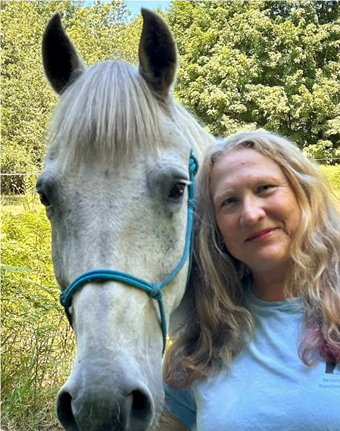
Jan Stump, MSW, is the Peace Ranch Executive Director and has worked for over 40 years helping people with trauma and loss find recovery and hope, with the last 15 years focused on equine assisted experiential therapy. Peace Ranch clients include children who have experienced trauma, including foster and adoptive care, veterans with combat trauma, families and caregivers needing support.
Peace Ranch restores hope and transforms lives. It is a faith-based counseling program founded in 2010 as the legal outreach of Paraklesis Inc., a 501c3. The program is funded by fees, grants, events, sponsors, and volunteers. Peace Ranch has a number of contracts with community agencies in the area. The ranch is located in Hoosier Valley, near the 31/37 corridor in Traverse City. Staff includes trauma experts with advanced training in trauma recovery. The ranch is open year-round and provides services to children in foster care and adoption, caregivers, veterans, and families primarily, focusing on education and training. Most programs are outdoors as it helps with the therapy.
There are a variety of sponsorship levels where you can sponsor a horse (or other animals) and provide for all the needs, including hay, feed, hoof care, health care, and upkeep of their home. Sponsors also provide for any special health, training, or equipment needs of their horse, guaranteeing they receive individualized care.
There are three areas of equine therapy: medical model; education/recreation model; and psychotherapy model. The medical model focuses on a client's medical goals and is usually facilitated by an OT or PT staff member. This program requires a doctor's order. Therapy sessions are not usually “mounted,” that is, actually on the horse. The education/recreation model focuses on a client's social goals and is usually facilitated by an equine professional. No doctor's order is required for this program. Therapy sessions are mostly on the ground with the horse, i.e., out in the pasture, but can also include mounted therapy as well. The Horses for Heroes, a program that provides equine-assisted therapy for veterans and first responders, helping with PTSD, trauma, and physical limitations, falls into this model. The psychotherapy model is a clinical mental health program that focuses on complex trauma. This is a team approach model that includes the client, horse(s), equine specialist, and a mental health professional, and empowers the client to find the best solution to find and build strength. Most of the programs are on the ground as it is more of a relationship-building process with the horse and most therapeutic. Being outdoors and in nature assists with finding tranquility.
Horses are very unique animals. They are a prey animal and highly sensitive to what comes in its space and provides a good example of “fight or flight,” a survival instinct prioritizing an immediate flight to escape danger which triggers their sympathetic nervous system for instant reactions; and this can help a client understand their own problems. Horses want to connect and it is a relational process. It is safer when the horse or human can create some distance if needed. A client has to gain the trust of the horse to be able to put a harness on as staff will not do this. Most horses come from difficult situations and are looking for compassion as part of its recovery as well. Horses speak a body language and are very honest, and do not hold a grudge. The nervous system has to be flipped from trauma mode to rest mode. Actually, riding a horse, the motion, can help with the nervous system which leads to improved emotional regulations, reduced stress, and enhanced motor and cognitive functions.
The uniqueness of trauma is it is not a mental health issue, but lands in that category. It is actually a neurobiological change, and it disrupts the brain and nervous system. This is something that cannot be “talked out," but requires neurobiological intervention. When trauma occurs, the brain changes without permission and will continue to be an alarm until intervention begins. The neuro-sequential model begins with the lower brain, which is the sensory system and movement. This would include walking with the horse(s) outside in nature focusing on the rest and digest mode. From the lower brain you progress to the mid-brain, which is the stage of relationship and compassion, self-management of emotions, where you are actually building a relationship with the horse(s). Neo-cortex is the last area of engagement in the higher brain, and this focuses on reasoning, planning, and actually administrating. This model comes naturally as the brain starts to integrate.
Tours of the ranch are available, and preference would be to have the tour in June-August. Volunteers are needed for maintaining the horses and assisting with larger groups or special events.
To view a recording of Jan's presentation, access the Club's unlisted YouTube channel by clicking the following link. https://youtu.be/48Jr0AcP8pA