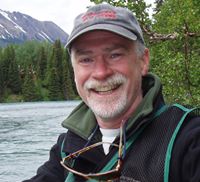
Dr. Mark Luttenton is a professor of Biology in the R.B. Annis Water Resources Institute, and is part of the Faculty of Grand Valley State University. Dr. Luttenton has received the GVSU Alumni Association's Outstanding Educator Award, and has been nominated for the Michigan Distinguished Professor Award and the U.S Professors of the Year Award.
The R.B. Annis Water Resources Institute has been in existence for 40 years. The institute has three main focuses: education outreach, ecological research, and joint appointments with biology and sociology. Research overview includes fisheries biology, molecular ecology, invasive species, microbial ecology, lake restoration, geospatial analysis, long-term monitoring, environmental toxicology metals, beach monitoring, and Great Lake research. Dr. Luttenton’s research has included a range of topics. More recently, his research has focused on population dynamics of the parasite causing swimmer’s itch, impacts of New Zealand mud snails on stream communities, salmonid diseases, aquatic fungi as a source of compounds to treat pediatric cancers, and ecological changes in Higgins Lake, and the Au Sable River.
Most things in life are luxuries, but water is essential for life for direct consumption and agriculture. Dr. Luttenton explained there are three water eras In the first era, water relative to population was unlimited. In the second era, populations start to urbanize, for example, Rome, the Mayans, wherein populations exceed available water resource. The third era develops as the second era closes out, and over a billion people lack clean drinking water, and 2.5 billion lack sanitation (more that the entire global population in 1944). In the beginning of the third era, developed countries with existing but aging infrastructure, 218 million people live within 10 miles of highly polluted water. Third era issues will not be solved with second era ideas. Agencies and organizations need to work together to develop solutions and remedies for good water quality for the future. These agencies and organizations include the Department of Agriculture, Health Department, DOT, Planners, and EGLE. Most actions take place at the local level whether the agency/organization is, i.e., international, regional, or local. HANWASH, Rotary 6290, is working to provide clean, fresh water to Haiti, and is a very successful model. Recognizing that sufficient clean water is essential to a healthy planet, Dr. Luttenton has now expanded his work into the area of water resource policy and established the Master’s Degree in Water Resource Policy in 2019. The program now draws students from the U.S. and several African nations.
At the Great Lakes/Regional Level, local actions are relatively easy to define. Benzie County has a tremendous amount of water resources, and protecting these resources is critical. Working with the local watersheds is an important part of protecting resources. Michigan is considered a water rich state, but not at the local level. At the local level, you want to look at the water supply, aging infrastructure, private wells; water quality, and if the water has contaminates, i.e., lead, nitrates, E. coli, and PFAS. Common strategies are to prevent the problem before it develops, i.e., over-development with septic and wells. If a problem exists, define the problem, understand the cause and possible solutions, and form partnerships. It is important to educate the stakeholders. The best action is to plan, design, implement, and then evaluate. The ultimate goal is to provide a water supply that is clean and supports the needs of humans and the ecosystem.
To view a recording of Mark's presentation, access the Club's unlisted YouTube channel by clicking the following link: https://youtu.be/NJ-MxBtISxA